On Writing
The AI editor that doesn’t rewrite everything
Clarity sticks. Padding doesn’t.
June 29, 2026
You asked for one thing and got a rewrite. Ask a general-purpose model to tighten a sentence and it returns a new paragraph: your point restated, a transition you didn’t write, a closing flourish you’ll delete. The fix you wanted is in there somewhere. Now you have to find it, and then check that nothing else moved.
This isn’t a bug in any one model. Generation is what these systems are built to do. Adding is easy. Restating is easy. Stopping is hard, because stopping requires a verdict: the sentence was already right. A model that only knows how to produce text has no natural way to produce “leave it alone.”
Why more words is the wrong default
Every edit that adds words adds surface area for the reader to slide off. A hedge here, a qualifier there, a sentence of throat-clearing before the point. None of it is wrong, exactly. All of it is friction, and friction is where ideas fail to stick.
Padding doesn’t make writing more impressive. It makes it easier to forget. Your reader has a fixed amount of attention, and every word that isn’t the point spends some of it on nothing.
What the smallest sufficient edit looks like
Take a sentence from a real-world status update: “We believe that, in most cases, the onboarding flow is probably the main thing that is causing users to drop off.”
A typical AI edit returns something like: “Based on our analysis, we’ve identified that the onboarding experience appears to be a significant contributor to user drop-off. This suggests an opportunity to revisit and streamline the onboarding journey to improve retention outcomes.” Longer, smoother, and worse. The hedges are still there, dressed better, and two new ideas have arrived that nobody asked for.
The smallest sufficient edit is: “The onboarding flow is where users drop off.” Nine words. Nothing added. The hedges were the problem, so the hedges went, and the point stayed exactly where it was.
Sometimes the smallest sufficient edit is no edit. The sentence was already right, and the honest response is to hand it back unchanged. We treat that as a success. An editor who changes things to justify being there is not an editor you can trust.
How Write to Stick enforces restraint
Write to Stick is built around a single discipline: make the smallest change that satisfies the instruction. An edit that rewrites a paragraph to fix one clause is treated as a failed edit, not a generous one. That rule is written into the model’s editing instructions, not bolted on as a filter afterward: the edit may not come back longer than what you selected unless you asked for more, it changes only what your instruction names, and handing your text back unchanged counts as a correct answer. Mechanically, an edit can only replace the passage you selected, and nothing lands until you accept it. The result is that what comes back is the fix you asked for, in the place you asked for it, and the rest of your text is untouched.
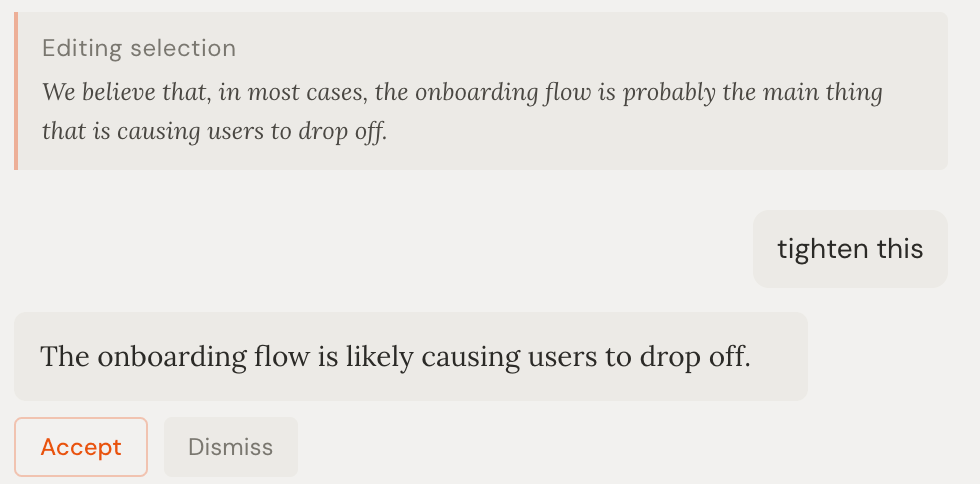

That’s not a safety feature or a style preference. It’s the product thesis. Clarity is what makes an idea stick, and clarity is mostly subtraction.
What this means for your draft
Select the sentence, not the page. Give a specific instruction, not “make this better.” And when the edit comes back unchanged, read that as information: the tool looked, and the sentence held.
The job of an editor is to take away everything that isn’t the point, and then leave the point alone. If you want to see what that does to an argument rather than a sentence, read Structural editing vs. copyediting.