On Writing
Structural editing vs. copyediting: why readers bounce off arguments, not commas
A weak link breaks the chain.
June 22, 2026
There are two kinds of editing, and only one of them has tools.
Copyediting works at the sentence: grammar, word choice, passive voice, consistency. Every writing assistant does this, from the spellchecker in Google Docs to Grammarly to whatever your email client just suggested. Structural editing (publishers call it developmental or substantive editing) works on whether the piece holds: what it claims, in what order, and whether the evidence carries the conclusion. Book editors do this. Nobody does it for your 900-word post, your board memo, or the sales email that has to land on Tuesday.
Where readers actually leave
A typo costs you a wince. A broken claim costs you the reader.
They don’t leave at the comma splice. They leave at the leap in paragraph four, the statistic that proves less than it appears to, the conclusion that’s bigger than its premises. And they don’t think “structural flaw.” They think “hm,” and stop trusting you, and skim the rest.
An argument is a chain
Thesis, claims, evidence, conclusion. It’s only as strong as its weakest link, and the writer is the worst-placed person to find that link, because the writer already believes the argument. Fluency makes it worse: a well-written weak claim reads like a strong one right up until someone pushes on it.
A worked example
A product memo argues: “Churn rose in Q2. We launched the new pricing page in Q2. The pricing page is driving churn; we should roll it back.”
Copyedit it all you like. The sentences are fine. The chain isn’t. Two things happened in Q2; the memo has only checked one of them. A structural edit doesn’t fix a word, it asks a question: what else changed in Q2? Maybe the support team was restructured. Maybe a big customer was always going to leave. The fix is a sentence of evidence, or a smaller claim (“the pricing page is one candidate”), not a better verb.
That question is the whole job, and no grammar tool asks it.
How Write to Stick reads your piece
It reads the way a skeptical reader will. It names your thesis in one line, traces the chain of claims that carries it, and points at the link most likely to snap first. Not a list of everything that could be better; the one place where the chain breaks. Fix that, and the piece survives contact with someone who wanted to disagree.
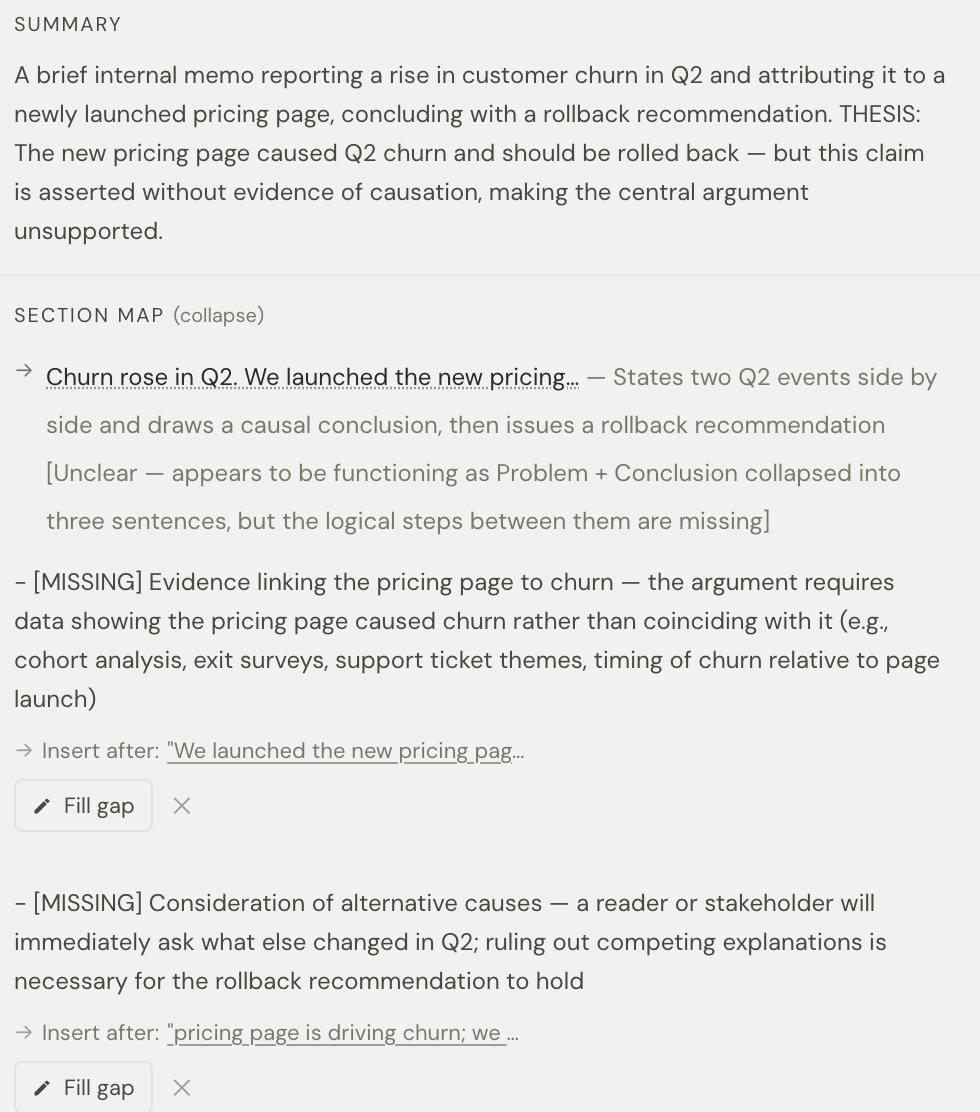
This sits alongside copyediting, not instead of it. Polish the sentences too. Just don’t mistake polished for sound.
How to do it without a tool
Write your thesis in one sentence. List the claims that carry it, in order. For each claim, write the one thing a hostile reader would say. The claim you’d least want challenged is your weakest link. Fix that one before you touch a comma.
And if the weakest link turns out to be a number you don’t actually have, that’s a different problem with its own fix: mark the gap instead of filling it.